I Was Going to Be a Journalist. Then Woodworking Got in the Way.
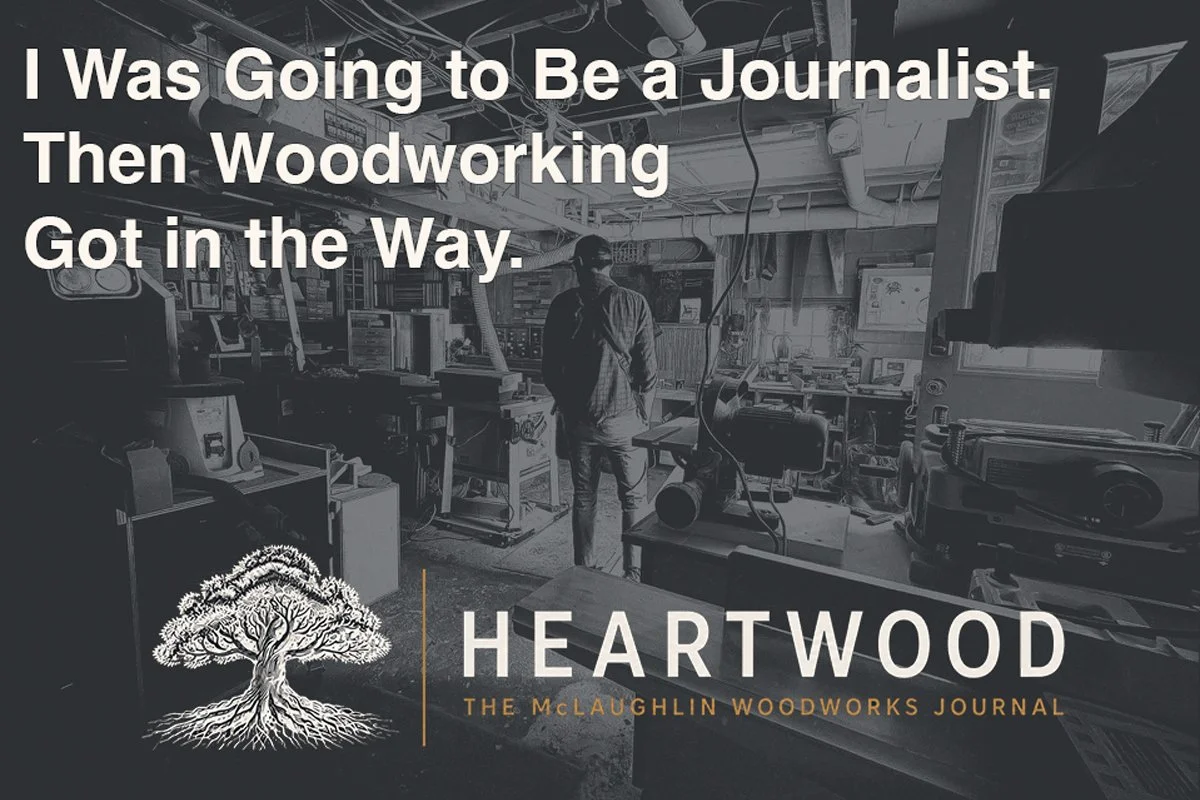
So… this is happening. I'm blogging.
As a journalism student at American University, blogging, if it even made it onto the list, would have been the last thing I wanted to do – unless my life had taken a dramatic turn for the worst (I mean, blog is the sound I make when I have to do something I don't want to do). Blogging about woodworking, making fine furniture, and operating a small business? I would have assumed I'd been kidnapped and forced to write about dovetails and coping saws at gunpoint. Well, here I am – and don't worry, I'm perfectly safe; I'm currently sitting at my desk with a cup of coffee while Gus the Shop Dog, fur matted with sawdust, sleeps at my feet. However, my life did take a dramatic turn, but it wasn't for the worst. It hasn't been easy, but it wasn't what I'd imagined I'd be doing with my life. So why am I doing this? Because I love building furniture. I guess I blog about it now.
So, you know... Welcome to Heartwood, the shop journal for my business, McLaughlin Woodworks... or something. Blog.
Woodworking was never part of the master plan. Like many things in life, it blindsided me. It caught my attention and drew me in. It was like picking up a camera for the first time and realizing I wanted to be a photojournalist, learning to play the guitar, or riding my first motorcycle. It was consuming. It took up way more real estate in my brain than it ought to have. My dad was a woodworking hobbyist–I helped him build his first acoustic guitar when I was 15, and I still play that guitar to this day–and my uncle was a very talented carpenter who worked on Victorian homes in the Baltimore area. But woodworking never really captured my attention. From the ages of 16 to 33, my sole pursuit in life was journalism. Sure, I had a couple of detours – Marine Corps, frame carpenter, musician, deckhand on tugboats – but I never lost focus on my goal – until I built my first piece of furniture.
It was a kitchen island for my mom. I went out and bought some reclaimed oak, ordered some pine table legs that I distressed to match the oak, and sanded down the butcher block counter my uncle had made when I was still in diapers. I pocket-screwed everything together, and… ta-da!
It was incredibly basic, but I loved it. I wanted more, so I built a 14-foot-high built-in bookcase with a sliding librarian ladder and paneled cabinet doors – it was a very ambitious undertaking for only my second outing – but I figured it out. I worked the problems as they came and, in the process, became a better carpenter. So I did it again. I went out and bought some reclaimed hemlock and some old oak flooring. I built a paneled desk with a flip-up desktop and dovetailed drawers (I'm currently writing this at the desk, and the dovetail drawers are only the second worst drawers I've ever made, and the flip-up desktop has warped to the point where I have to keep an eye on my coffee mug so it doesn't slide off the back of the desk – lessons learned.). This time, however, I re-sawed all the hemlock on my dad's crummy old SEARS Craftsman bandsaw. And rather than using 1/4 inch birch plywood for the panels, I glued up some hemlock to make my own panels. I was making it up as I went and loving every second.
In 2018, I managed to talk my way (cough – bull-shit my way) into a job at a small lumber company in the Baltimore-Washington area that specialized in reclaimed lumber (If you are in the area, check out Stevo's Reclaimed). I spent four months lugging heavy timbers and stacking and stickering lumber before Steve let me operate the sawmill. But when he did, I was hooked. The Woodmizer LT40 was a massive step up from that old SEARS bandsaw. Instead of re-sawing 6-inch boards with varying results, I was turning trees into lumber, sometimes hundreds and thousands of board feet at a time. I learned that having the capability and skills to turn a tree into fine furniture was incredibly satisfying. And I did just that.
I kept on building furniture and eventually started making money doing it. By 2019, I was supplementing my income at the lumber yard by building mudroom lockers and built-in cabinetry. In 2020, at the height of the pandemic, I started McLaughlin Woodworks — an endeavor that's been exciting, terrifying, stressful, an absolute joy, and a pain in my ass—sometimes all in the same afternoon. And, somewhere in the last six years of doing this, I got better. Not just at running a business. At actually building and designing furniture.
I began to realize that the best pieces of furniture I was making in the shop were pieces where I worked hand-in-hand with the client to help them build a specific piece that would serve a specific purpose, for a specific space. I helped solve some pretty unique problems with thoughtful design, and it was through this purpose-driven design that my clients were served best. It started to become the standard by which I measured my work–a standard that I would eventually begin to call the Bespoke Standard.
McLaughlin Woodworks became a business focused on this standard. It was no longer a business that took on odd and random woodworking projects–and yeah, there were a lot of bad ones over the years. Instead, it became a business built around designing and building furniture for the client's specific needs, solving a problem for them, no matter what that problem may be. Everything done within the business served that single purpose. As a result, the craftsmanship actually started living up to the standard, and the shop schedule was consistently booked.
But with growth comes more problems (will it ever end!?) I suddenly found myself in the position of not having the space in the shop to take on every single job. So I had to adjust. I had to make sure every job earned its keep on the shop floor. I had to cut the fat and tighten how I moved clients from the design phase to the finished product. And, by doing so... I grew again. I'd inadvertently developed a process that works. Something that clients connected with. Something that gave them a voice in the process. Rather than building generic "custom" furniture (here is another custom table that looks just like all the other custom tables–now pay up), I sat down with them and learned what they really needed. Together, my clients and I have created truly one-of-a-kind pieces that served a real-life function in their homes and businesses. Today, I have moved from being the guy driving around in a beat-up old truck with tools piled in the back–you know the guy–to a legitimate design studio with brand identity.
I know. "Oooooh, brand identity!" It sounds like a buzzword used by "Long Haired Businessmen"—look it up. I'll be honest, I don't know the first thing about marketing. Social media, ad campaigns, all of it mostly baffles me. Give me a break — the technological innovation I use most on a daily basis, the chisel, was invented by cavemen. My point being, I'm no social media influencer.
But this — the shop, the sawdust, the standard I hold every piece to — I know. That's what Heartwood is actually for. The name comes from the tree itself: heartwood is the dense, non-living core at the center of the trunk, the part that gives the whole tree its strength, built from years of growth that came before it. That's what I want this journal to be — the old projects, the lessons learned, the decisions behind the work, all of it building toward something solid. Some of what I write here will be for the woodworking nerds like me: the process, the joinery, the decisions that go into building something meant to last. Some of it will be for people trying to figure out if custom furniture is for them. Either way, it's the same thing I've been doing since that first kitchen island: figuring it out, one project at a time, and telling the truth, blunders and all.